



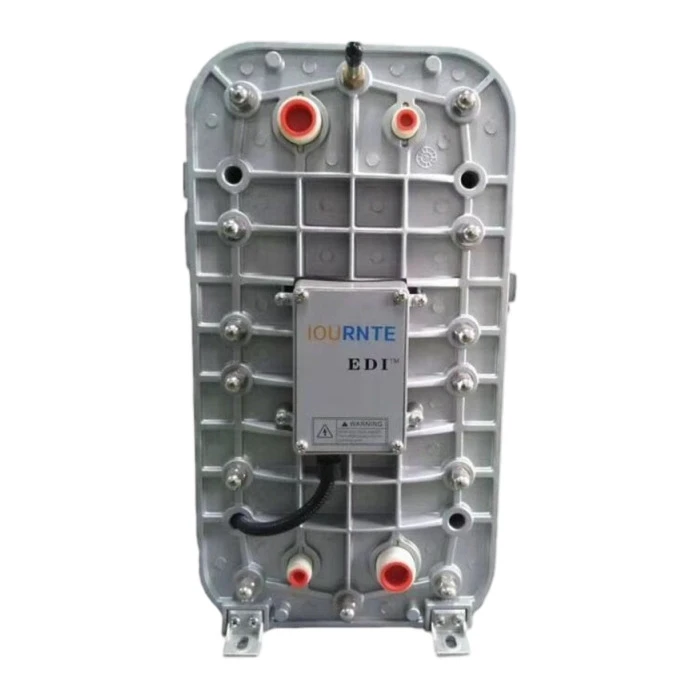

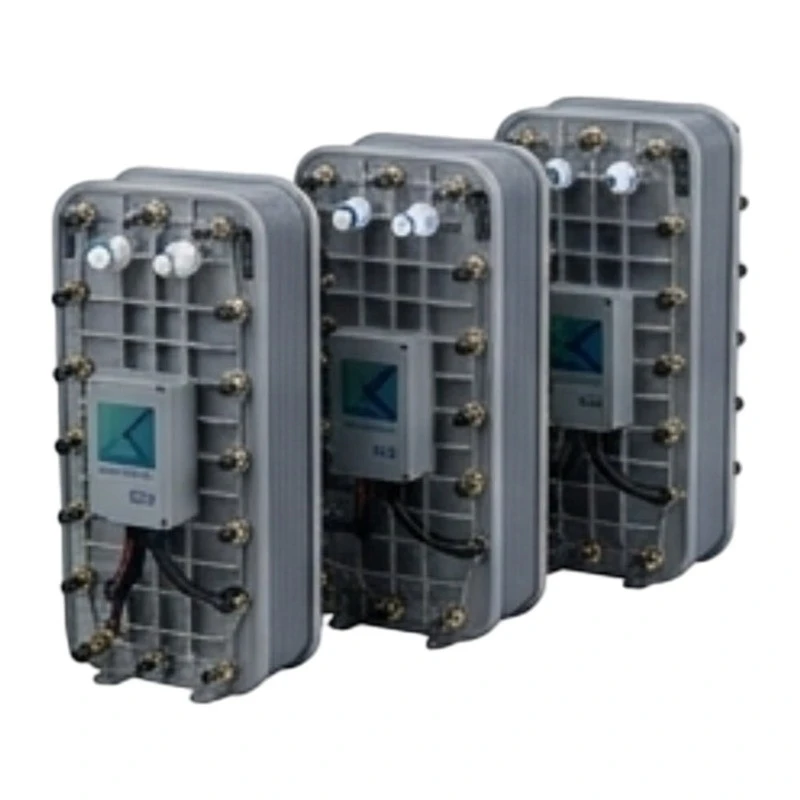

Fujian Huamo Technology Co., Ltd. is one of the most reliable manufacturers and suppliers of high flow edi module in China. If you're going to wholesale bulk high flow edi module made in China, welcome to get catalog and price list from our factory. All custom made products are with high quality and competitive price. Also, OEM service is available.
Product Details
High flow EDI module provide reliable continuous ultrapure water production for laboratories, pharmaceutical facilities, and precision manufacturing applications. With a standard product flow of 500 L/H, the module effectively removes residual ions following reverse osmosis treatment, ensuring stable water quality for demanding processes.
Producing water with resistivity up to 18.25 MΩ·cm and achieving a recovery rate of 90–95%, the KXA-50 helps reduce water consumption while maintaining consistent purification performance. Its compact footprint, low operating requirements, and chemical-free regeneration process make it an efficient solution for modern high-purity water systems..
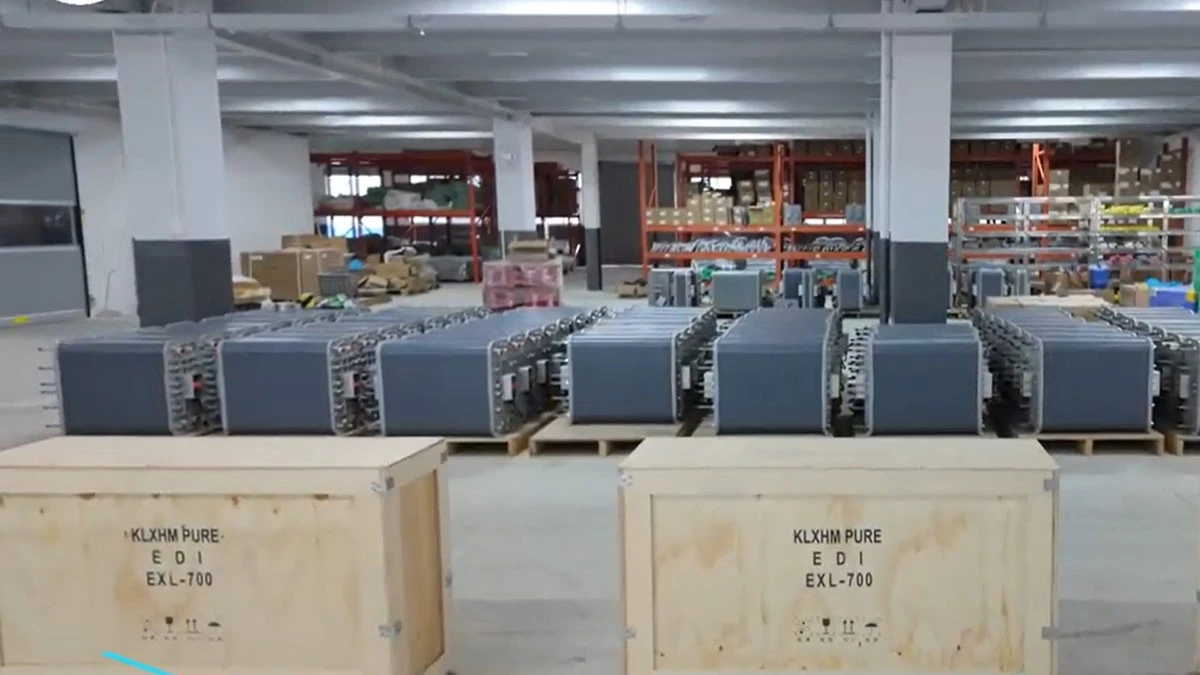
Product Specifications
Parameter | Specification |
Model | KXA-50 |
Standard Product Flow | 500 L/H |
Product Flow Range | 0.3–0.7 m³/h |
Product Water Resistivity | 15–18.25 MΩ·cm |
Recovery Rate | 90–95% |
Operating Current | 1–6 A/DC |
Operating Voltage | 0–400 V |
Feed Pressure | 1.5–5.0 bar |
Pressure Drop | 1.4–2.1 bar |
Operating Temperature | 5–35°C (Best at 25°C) |
Feed Water pH | 6.5–9.0 |
Dilute Port Connection | DN32 External Thread |
Concentrate Port Connection | DN20 External Thread |
500 L/H EDI Module Application & Maintenance Overview
500 L/H EDI modules are typically used in medium-scale ultrapure water (UPW) production systems. Examples include centralized laboratory water supplies, pharmaceutical preparation loops, microelectronics cleaning lines, and small industrial pure water skid-mounted units. In most configurations, high flow EDI module is installed downstream of a single- or two-stage reverse osmosis system as a final purification unit to achieve stable resistivity up to 15–18.25 MΩ·cm.
Regarding maintenance, EDI modules generally do not require routine chemical regeneration as traditional ion exchange systems. However, under certain operating conditions, CIP (in-situ cleaning) is recommended. If feedwater quality control is poor, or if significant performance degradation occurs, such as increased pressure drop, decreased resistivity, or unstable current, periodic CIP cleaning should be performed to restore stack efficiency. In well-designed systems with stable reverse osmosis pretreatment, CIP cleaning is typically less frequent and may only be required during preventative maintenance cycles.
Overall, the high flow EDI module 500 L/H is designed for low maintenance and continuous operation, but proper pretreatment and monitoring are crucial to ensuring long-term stable operation and extending module life.

FAQ
Q: Can the EDI module operate continuously 24/7?
A: Yes. The EDI module is designed for continuous 24/7 operation in industrial ultrapure water systems. Unlike mixed bed ion exchange systems, it uses electrical regeneration technology, enabling continuous ion removal without shutdown, stable resistivity output during long-term operation, and no regeneration cycle interruptions. For optimal performance, stable feed water conditions and a constant flow rate are recommended to ensure reliable continuous operation.
Q: Do you provide OEM EDI modules?
A: Yes. We support OEM customization for EDI modules to meet different system integration requirements. This includes adjustments in flow capacity, connection interfaces, electrical parameters, structural dimensions, and branding. Our OEM service is designed for system manufacturers and water treatment integrators who require flexible configuration and stable long-term supply for their ultrapure water systems.
Q: Can EDI work directly after single-pass RO?
A: In many industrial designs, a two-stage RO system is typically chosen to achieve more stable EDI operation. The product water should have low conductivity, low hardness, and low silica content. A single-stage RO system can still be used if the feed water conditions are well controlled.
Therefore, for industrial ultra pure water systems, double-pass RO + EDI is the standard configuration for achieving stable high resistivity water quality.