



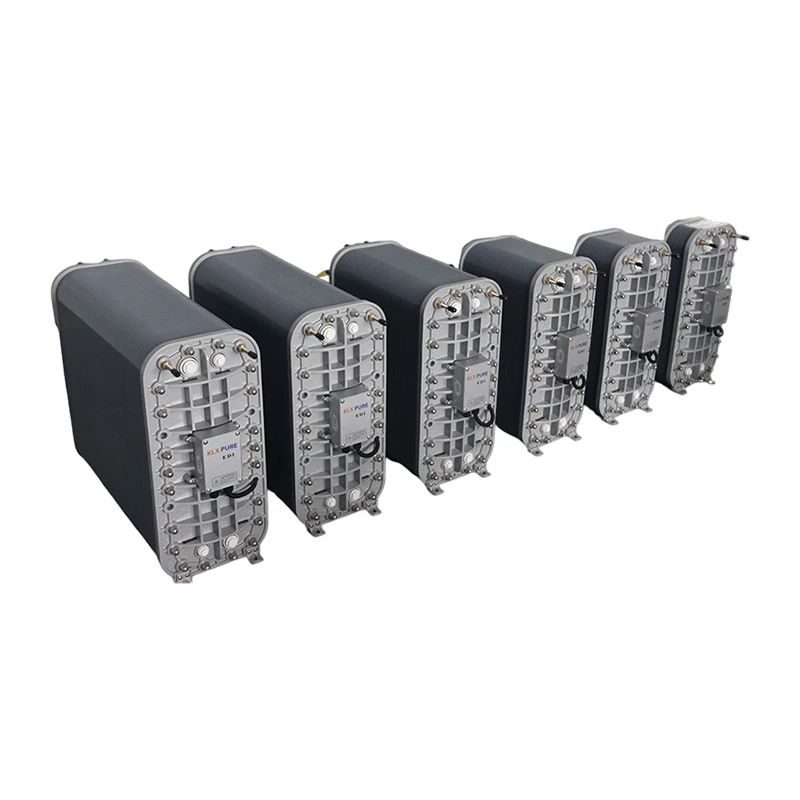


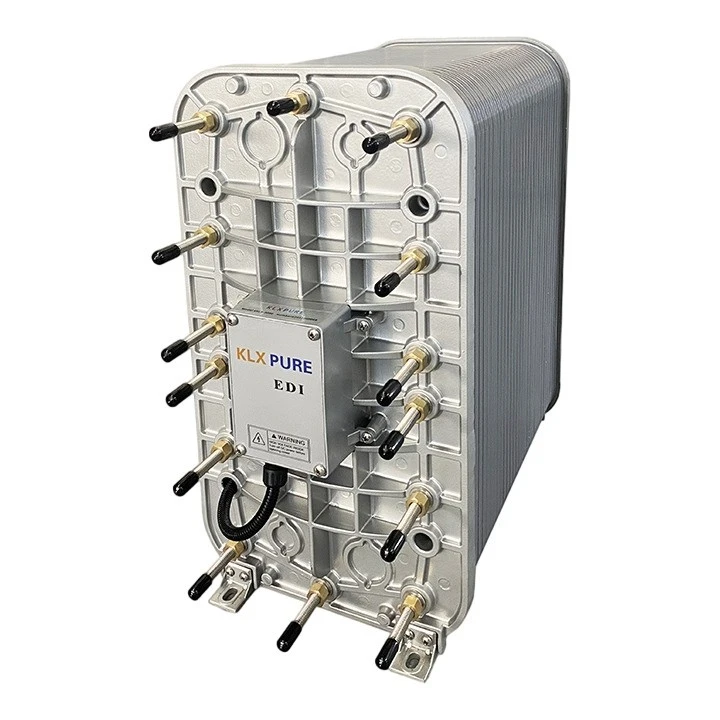

Fujian Huamo Technology Co., Ltd. is one of the most reliable manufacturers and suppliers of edi water purification system in China. If you're going to wholesale bulk edi water purification system made in China, welcome to get catalog and price list from our factory. All custom made products are with high quality and competitive price. Also, OEM service is available.
Product Details
The EDI water purification system is an electrically driven deionization solution designed for the end-stage purification of industrial ultrapure water production lines, installed after reverse osmosis equipment to continuously remove residual trace ions from RO permeate and produce low-conductivity, high-resistivity process water for industrial applications. As the core refining step of this purification process, the electrodeionization module targets residual ionic contaminants that are difficult to remove by RO alone: inside the module, ion exchange resin helps reduce conductivity, while ion-selective membranes separate anions and cations under electric potential to enable continuous, stable purification.
For manufacturing sectors requiring strict control of dissolved ionic contamination, this EDI water purification system delivers water with resistivity up to 18.25 MΩ·cm under standard operating conditions, achieves more than 99% removal rate for silicon and boron, maintains 90%-95% water recovery, and is perfectly suited for production environments where water quality consistency directly affects manufacturing processes and equipment stability.
Video Description
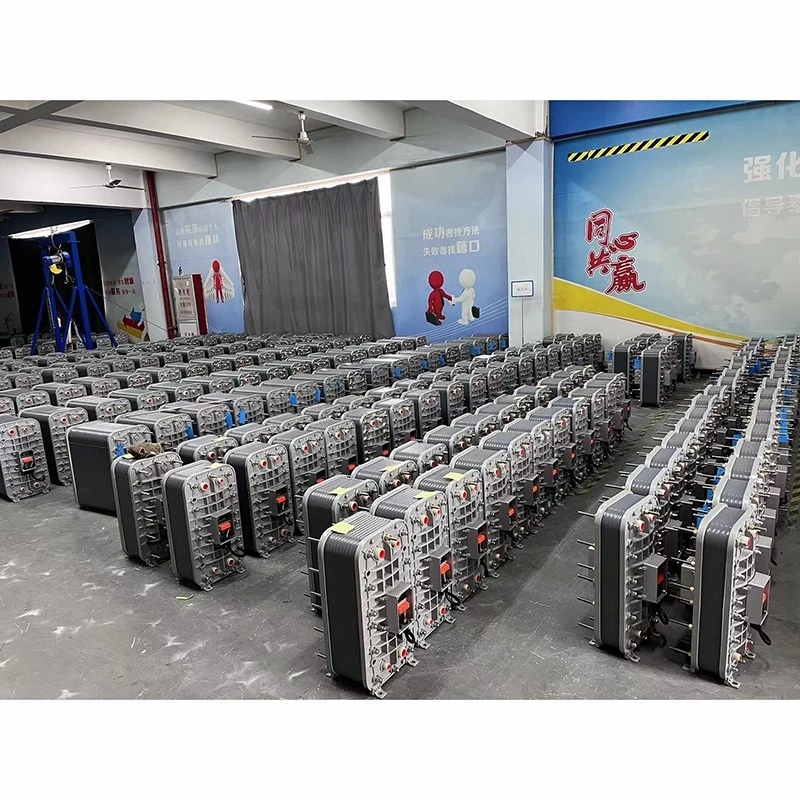
This technical video highlights our complete componentmanufacturing, stack compression, and automated structuralassembly procedures.
Product Specifications
Model | KXA-50 | KXA-100 | KXA-200 | KXA-300 | KXA-400 | KXA-500 | KXA-600 | KXA-700 |
Water Production Flow m3/h | 0.3-0.7 | 0.5-1.4 | 1.5-2.5 | 2.5-3.5 | 3-4.5 | 5-7.8 | 6-8.5 | 7.5-9.5 |
Recovery Rate % | 90-95 | 90-95 | 90-95 | 90-95 | 90-95 | 90-95 | 90-95 | 90-95 |
Standard Water Flow Rate L/H | 500 | 1000 | 2000 | 3000 | 4000 | 5000 | 6000 | 7000 |
Operating Advantages
- Stable ultrapure water output
- Continuous conductivity polishing
- Reduced regeneration downtime
- Lower chemical handling requirements
- Compatibility with automated process systems
- This operating structure supports long-duration industrial water treatment applications with reduced operational interruption.
FAQ
Q: What is the core working principle of an EDI module?
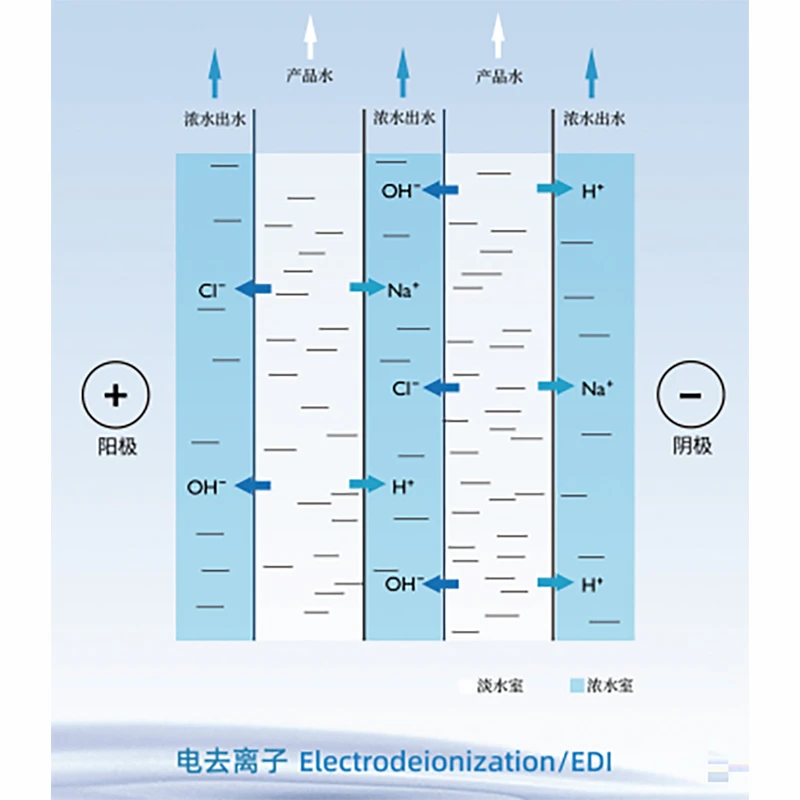
A: An EDI (Electrodeionization) module combines ion exchange, electrodialysis and electrochemical regeneration technologies. Driven by a DC electric field, anions and cations in freshwater migrate through their corresponding selective ion exchange membranes to the concentrate chamber for discharge. At the same time, the electric field ionizes water molecules to generate hydrogen ions and hydroxide ions, enabling continuous regeneration of ion exchange resins without the acid-alkali chemical regeneration required by traditional processes, allowing continuous production of high-purity water.
Q: What are the most common faults of EDI modules during daily operation?
A: Common faults in industrial scenarios can be divided into four main categories: First, performance faults, which are manifested as decreased water production, increased product water conductivity, and resistivity failing to meet standard requirements. Second, electrical faults, including abnormal fluctuations in current and voltage, and failure to power on normally. Third, structural problems, such as sealing leakage and membrane channel blockage. Fourth, aging problems, mainly natural attenuation of desalination efficiency after long-term operation. Most faults are related to unqualified inlet water quality, lack of regular maintenance, and unreasonable operating parameters.
Q: What impact will unqualified inlet water quality have on an EDI module?
A: If the hardness, organic matter, and residual chlorine indicators of the inlet water exceed the standard, it will directly cause fouling and contamination of the module: excessive hardness will form calcium and magnesium scale on the membrane surface and block the water flow channel; residual organic matter will contaminate the ion exchange resin and membrane, reducing the exchange adsorption efficiency; excessive residual chlorine will oxidize and damage the ion exchange membrane, causing irreversible performance attenuation, and will directly lead to scrapping of the module in severe cases.