



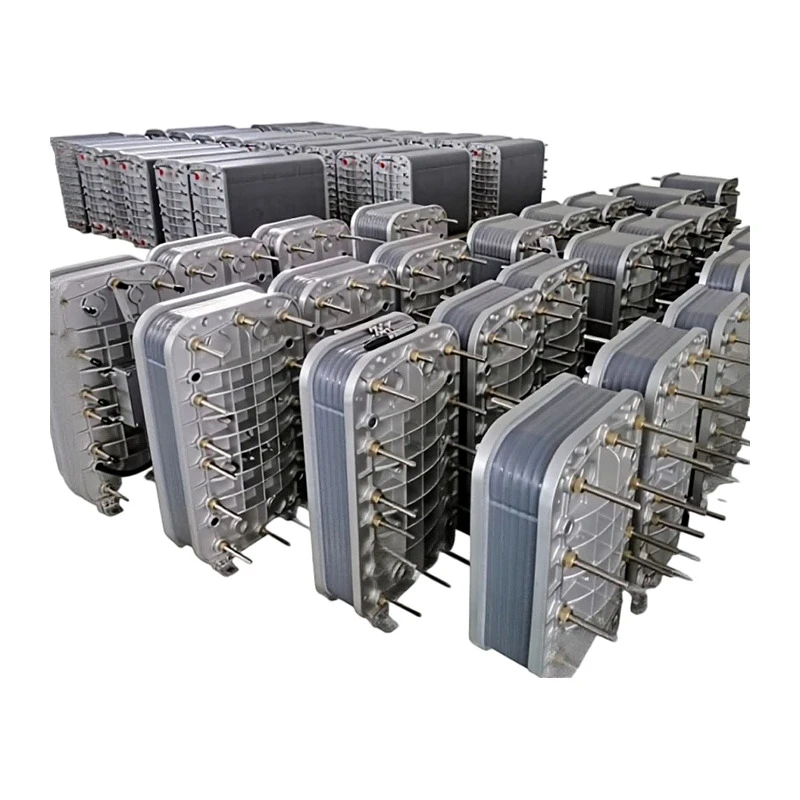
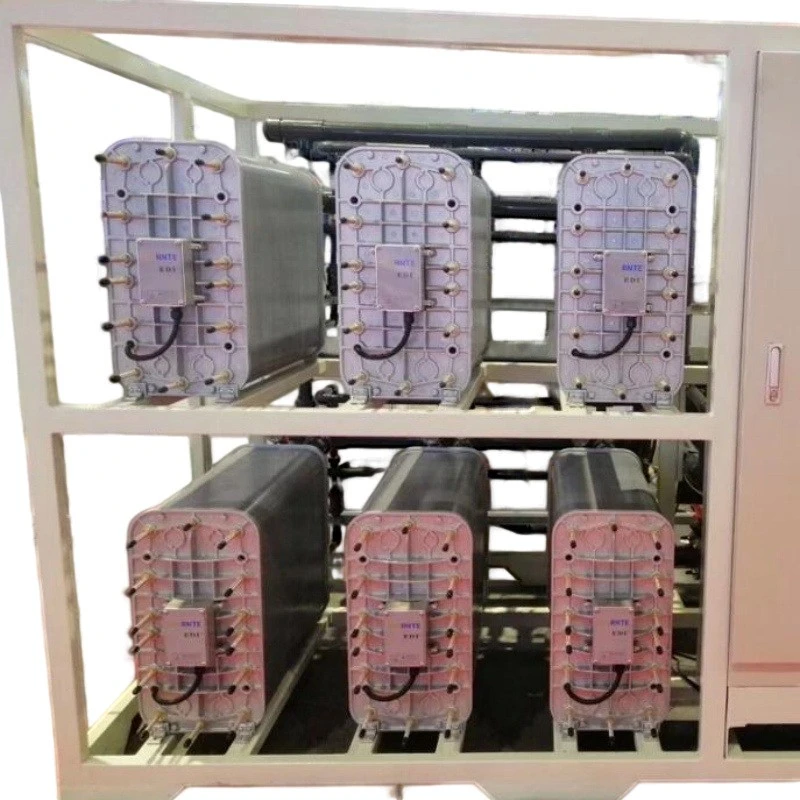
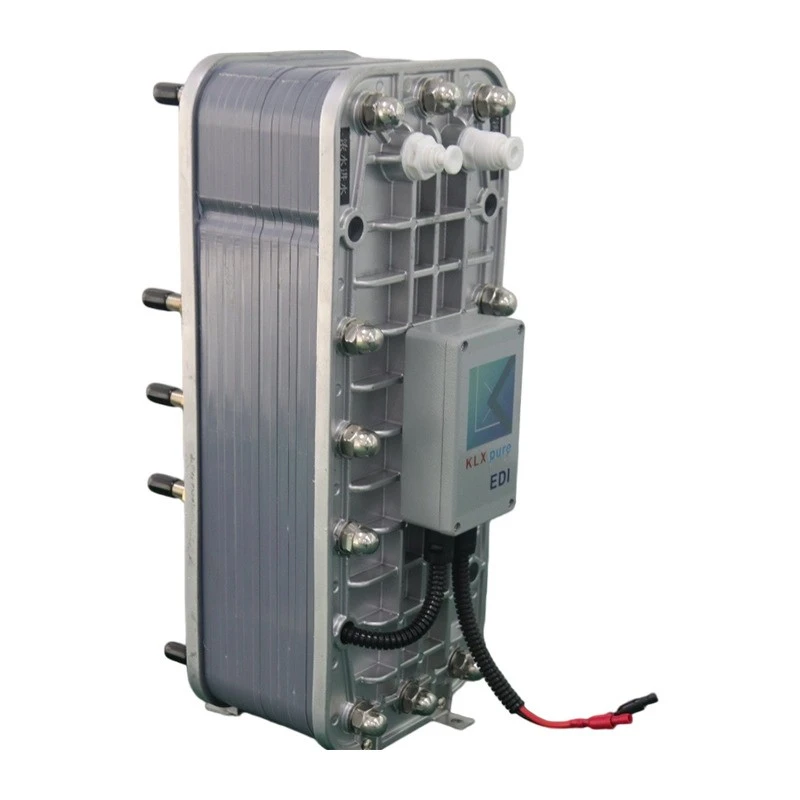
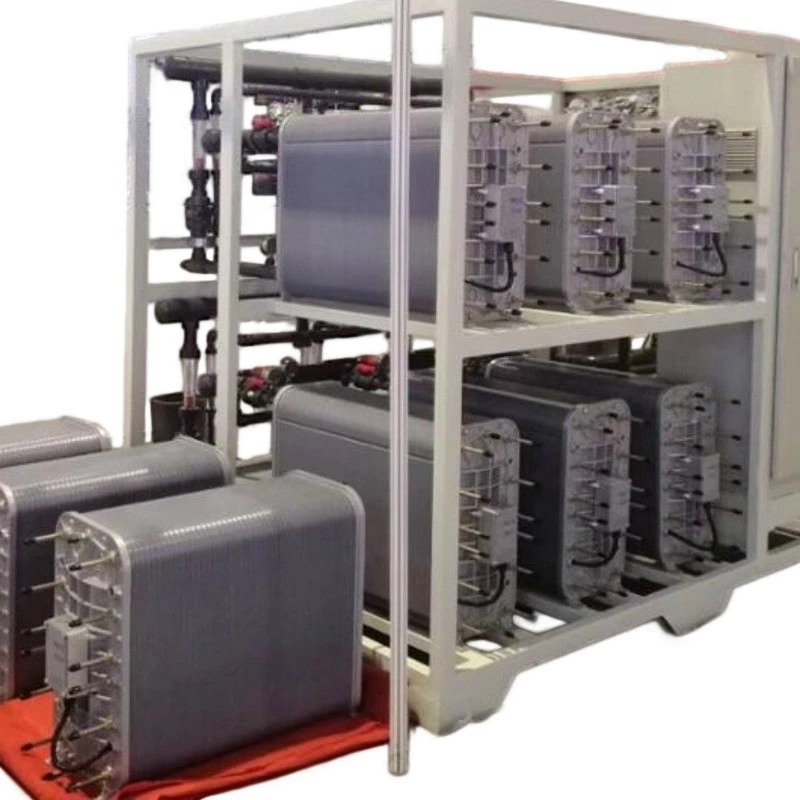
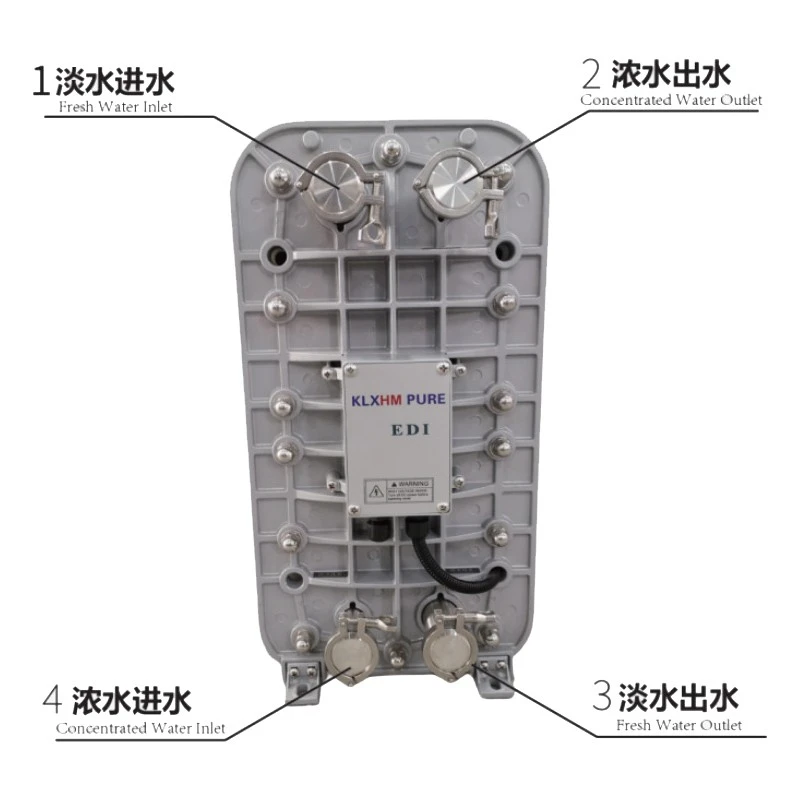
Fujian Huamo Technology Co., Ltd. is one of the most reliable manufacturers and suppliers of edi for ultrapure water system in China. If you're going to wholesale bulk edi for ultrapure water system made in China, welcome to get catalog and price list from our factory. All custom made products are with high quality and competitive price. Also, OEM service is available.
Product Details
EDI for Ultrapure Water System runs continuously with no regeneration cycle. Mixed bed ion exchange units require periodic regeneration with concentrated acid and caustic, producing large volumes of waste that must be neutralized before discharge. During regeneration, a mixed bed unit is offline, requiring a second standby unit or a storage tank.
The EDI system regenerates its resin in real time using H⁺ and OH⁻ ions from water splitting. The only waste is the concentrate stream – 5‑10% of feed flow – which contains the same ions removed from the feed water, with no added chemicals. In most locations, this concentrate goes directly to drain or back to the RO feed tank.
Video Description
How EDI for Ultrapure Water System replaces mixed bed – continuous operation, no chemical regeneration, and integrated system configuration.
Product Specifications
Parameter | KXGW-50 | KXGW-100 | KXGW-200 | KXGW-300 | KXGW-400 | KXGW-500 |
Working Current (DC, A) | 1-6 | 1-6 | 1-6 | 1-6 | 1-6 | 1-6 |
Working Voltage | 0-400 | 0-400 | 0-400 | 0-400 | 0-400 | 0-400 |
Water Production Flow Range (m³/h) | 0.3-0.7 | 0.7-1.5 | 1.5-2.5 | 2.5-3.5 | 3-4.5 | 4-5.5 |
Standard Water Production Flow (m³/h) | 0.5 | 1 | 2 | 3 | 4 | 5 |
Recovery Rate (%) | 90-95 | 90-95 | 90-95 | 90-95 | 90-95 | 90-95 |
Product Water Resistivity (MΩ·cm) | 15-18.25 | 15-18.25 | 15-18.25 | 15-18.25 | 15-18.25 | 15-18.25 |
Disinfection Temperature (≤0.2MPa) | 85±5℃ | 85±5℃ | 85±5℃ | 85±5℃ | 85±5℃ | 85±5℃ |
Disinfection Cycles | >150 times | >150 times | >150 times | >150 times | >150 times | >150 times |
System Components and Configuration
A standard EDI for ultrapure water system includes:
- Cartridge filter housing – 0.5 µm absolute rated, placed immediately before the EDI modules to capture any resin fines or particles from upstream.
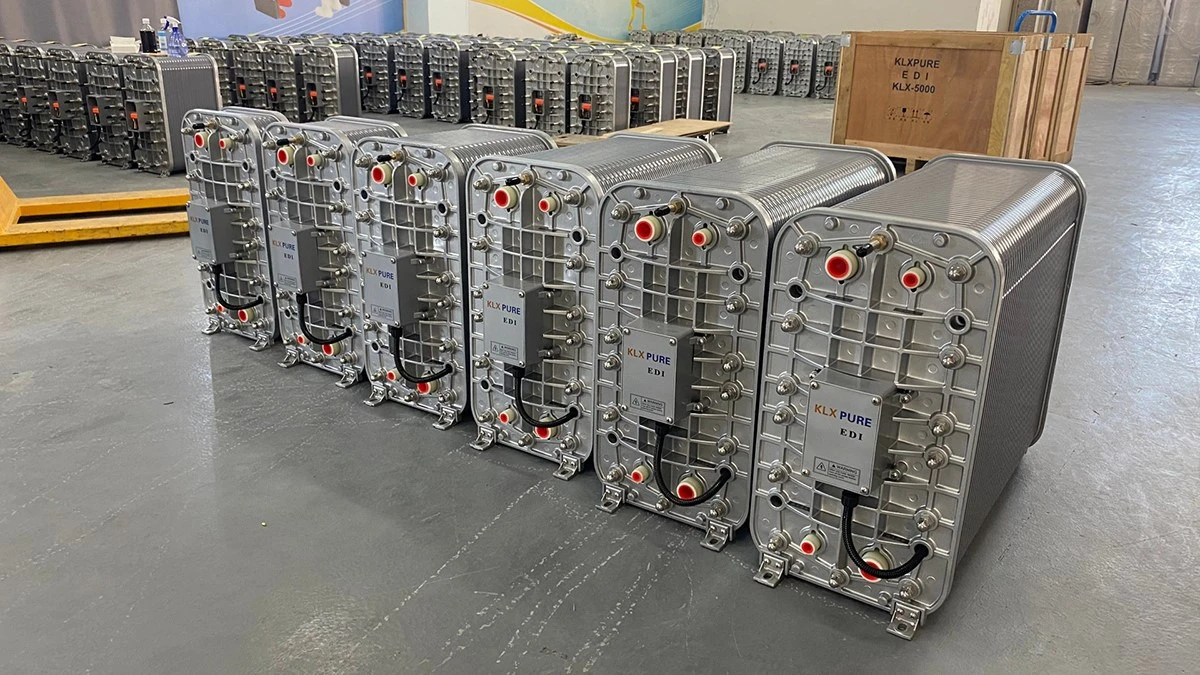
- EDI modules – KXGW series in the required number and size. Each module has individual flow control valves and rotameters for fresh water and concentrate.
- DC power supply – Constant current type with adjustable output. For KXGW‑50 through KXGW‑400: 0‑400 V, 1‑6 A. For KXGW‑500: 0‑100 V, 1‑6 A. Includes a flow switch interlock that cuts power when feed flow drops below minimum.
- Instrumentation – Resistivity or conductivity meters at module feed, product, and concentrate outlet. Pressure gauges at feed and concentrate inlet. Temperature sensor for compensation.
- Control panel – PLC or relay logic that sequences startup (water first, then power) and shutdown (power first, then water). Monitors flow switches, high feed conductivity, and low product resistivity.
RO + EDI System Integration
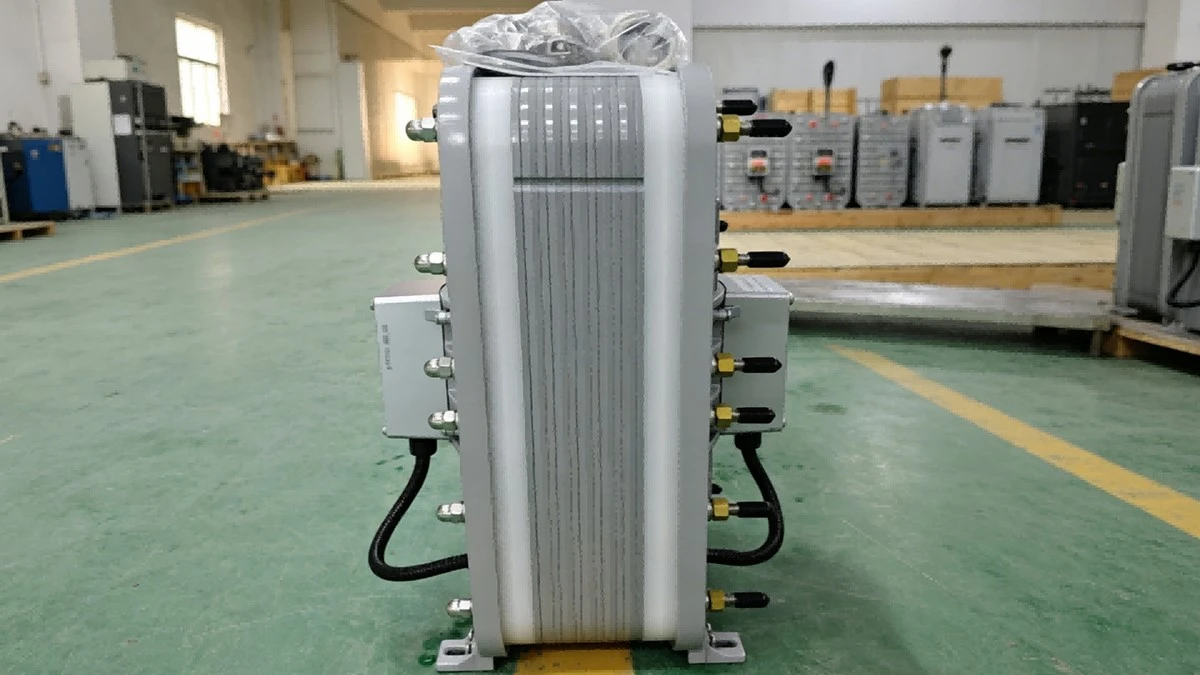
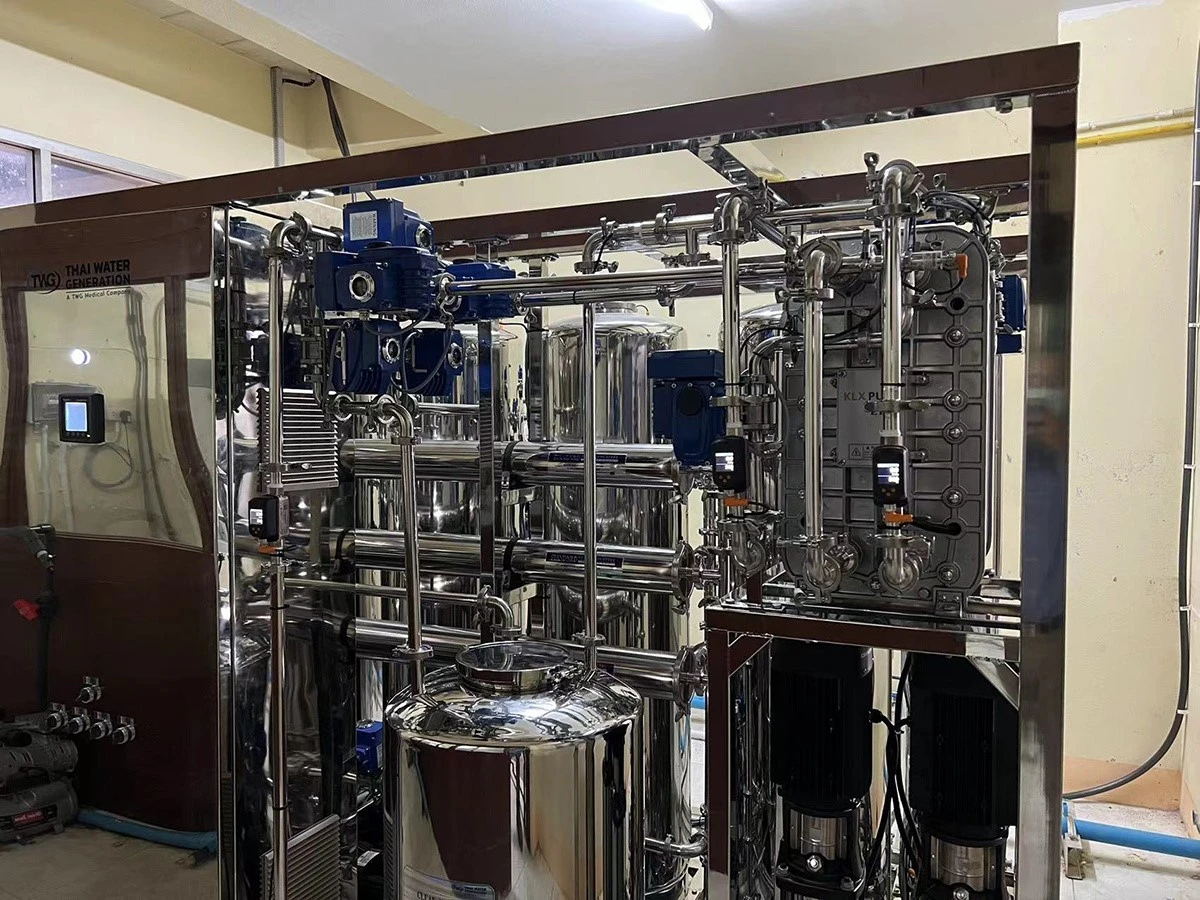
High Purity Water EDI modules are designed for integration downstream of reverse osmosis systems. RO pretreatment removes the majority of dissolved salts and organic contaminants before water enters the EDI stage, where residual ionic contaminants are continuously removed through electrically driven ion transfer.
The fully filled concentrate chamber design eliminates external brine injection requirements and reduces the need for additional concentrate circulation equipment, helping simplify overall system configuration.
High Temperature Sanitization Performance
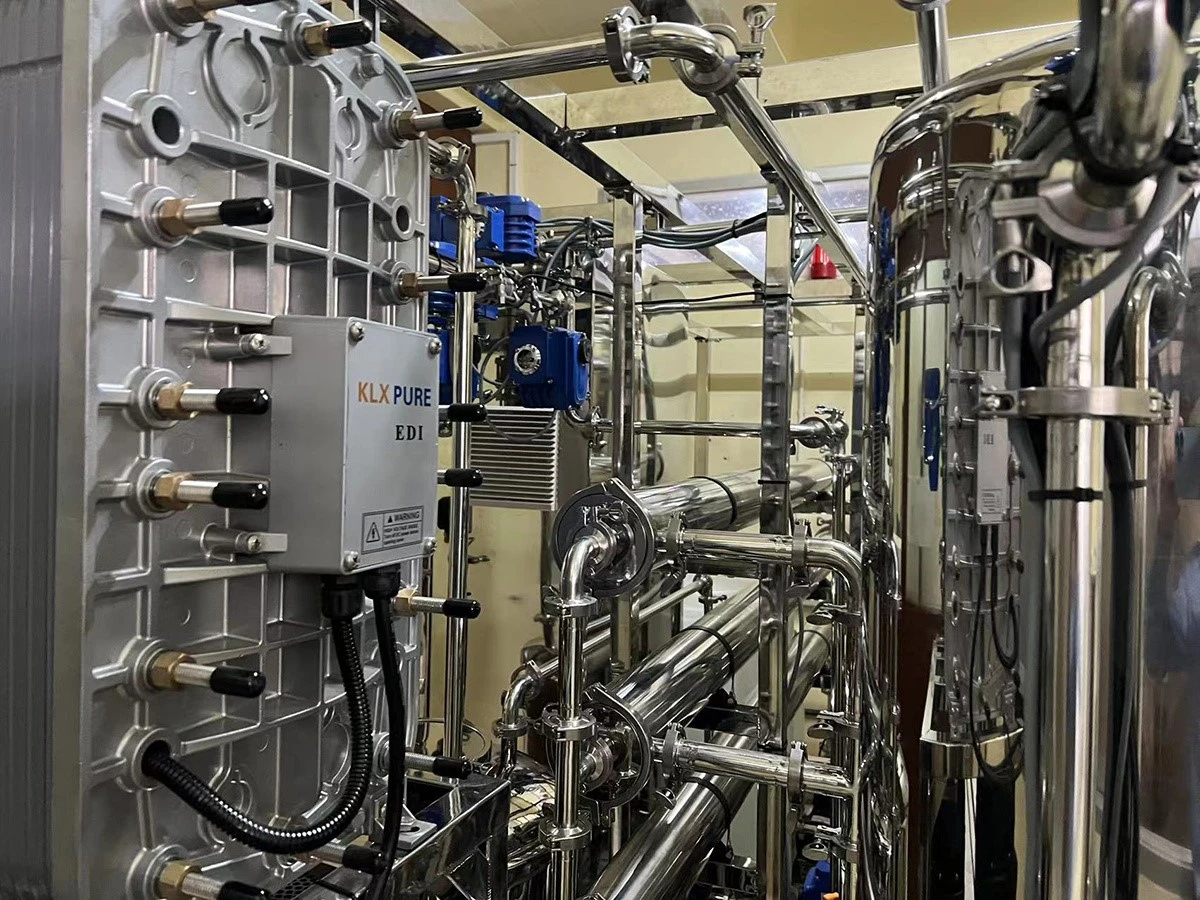
The high temperature EDI configuration supports repeated thermal disinfection procedures commonly used in pharmaceutical purified water systems. During sanitization cycles, the module operates at elevated temperatures while maintaining structural stability inside the concentrate and dilute chambers.
Compared with conventional EDI systems that require chemical sanitation procedures, thermal sanitization reduces chemical exposure inside the water treatment system and simplifies maintenance management in hygienic process environments.
FAQ
1. What type of acid should I use for cleaning, and what is the procedure?
Use 5% organic acid (e.g., citric acid) or 2.5% hydrochloric acid. Circulate the acid solution through the concentrate circuit only – do not let it enter the fresh water side. Run the pump for 30 minutes, then soak for 5 minutes. Drain and flush with deionized water until the outlet pH matches the inlet pH. Reconnect and resume normal operation. Always perform cleaning with the power off.
2. Does the KXGW module require a concentrate recirculation pump or salt injection?
No. The concentrate compartment uses a proprietary full‑fill design. No salt dosing, no recirculation pump, and no de‑gasifier are needed. This simplifies the system compared to older EDI designs.
3. What is the expected service life of the KXGW module?
With feed water meeting our requirements (hardness <0.5 ppm, chlorine <0.03 ppm, no scale‑forming ions), typical service life is 4‑5 years. Some users have operated beyond 5 years with regular cleaning. After that, we offer professional regeneration and repair services.