



If you've ever spent time at a remote construction site, off-grid mining camp, or emergency disaster response zone, you know how critical access to consistent, high-purity water is-even when every logistical detail works against you. For decades, mobile water treatment systems relied on reverse osmosis (RO) paired with mixed-bed ion exchange (MBIX) to produce water pure enough for uses like boiler feed or lab applications. But MBIX has its flaws: it requires constant chemical regeneration, generates hazardous waste, and needs frequent replacement, all of which are hard to sustain when you're miles from a permanent supply chain. That's where my team and I, as a large capacity EDI module supplier, get the most questions: Can a large capacity EDI module be used in a mobile water treatment system? The short answer is yes-but only if you tailor the module, its integration, and your operational setup to the unique constraints of mobile applications. Let's break down what works, what doesn't, and how we've seen our High Flow EDI Module solve real-world mobile water challenges over the last five years.
First, let's ground this in what large capacity EDI actually is, and how mobile systems differ from their stationary counterparts. EDI (Electrodeionization) uses electric current to split ionized water into hydrogen and hydroxide ions, which then remove dissolved solids (TDS) from feed water without chemicals. Stationary EDI modules are designed for fixed industrial sites-think pharmaceutical plants or power facilities-that have dedicated space, stable power grids, and routine maintenance schedules. Mobile systems? They live on trailers, ships, or temporary skids. That means they have three non-negotiable limits: size and weight, power consumption, and resistance to vibration, temperature swings, and variable feed water quality. Early EDI for mobile setups relied on small, low-capacity modules that maxed out at 10–20 gpm, forcing operators to either treat water too slowly or string together a dozen modules that doubled the system's footprint. Our High Flow EDI Module changed that by scaling large capacity EDI's core design to fit the tight weight and space constraints of mobile platforms.
But scaling EDI to work on the move isn't just about cramming more membrane stacks into a smaller frame. Stationary EDI systems run on steady feed water pressure, consistent TDS levels, and dedicated 60Hz power. Mobile systems? They often pull feed from a river, shallow well, or even temporary storage tank-feed water that swings from 500 to 5,000 ppm TDS overnight, hits unexpected turbidity spikes from storm runoff, and is fed by generators that fluctuate between 50 and 60Hz, plus 120/240V power. Over the last three years, we've worked with 17 mobile water system integrators to test our large capacity EDI modules in 11 different countries, from sub-Arctic mining camps in Canada to hurricane response sites in Puerto Rico. The biggest lesson from those tests: not all large capacity EDI modules are created equal for mobile use.
Take our High Flow EDI Module, for example. Its compact, lightweight frame cuts module weight by 35% compared to traditional large capacity EDI units, while delivering flows up to 80 gpm-enough to power 2,000 people, or a 5 MW boiler, for a remote site. But that's only part of the equation. Mobile systems can't afford the high power draw of stationary EDI, so we engineered our module to deliver the same water purity (1–2 MΩ·cm) as industrial EDI, but at 20% lower power use than comparable large capacity units. This ties directly into our Low Operating Cost EDI line, which is built to eliminate the hidden costs of mobile water treatment: no chemical shipping, no storage of regenerant acids and caustics, and 40% less downtime for maintenance. For mobile operators, that means less money spent on fuel for generators (since less power is used) and less time waiting for critical replacement parts.

Another common misconception: mobile water systems only need water for basic use, not for high-purity applications like boiler feed. But if you're running a remote mining camp's steam-powered equipment or a disaster response clinic that needs pure water for dialysis, the purity standard is non-negotiable. That's where the EDI Water Purification System comes into play. When paired with a properly sized RO pre-treatment, our large capacity EDI module delivers consistent high-purity water without the ups and downs of MBIX. In 2021, a mining client in Western Australia swapped their MBIX mobile system for a 120 gpm system using two of our High Flow EDI Modules. They reported a 60% reduction in chemical transport costs (previously, we had to haul 55-gallon drums of sulfuric acid and sodium hydroxide to the site every two weeks) and a 30% increase in water production uptime, even when their feed well TDS fluctuated by 1,200 ppm after heavy rain. That's a game-changer for remote sites, where supply chains are often delayed by road conditions or weather.
Of course, large capacity EDI isn't a one-size-fits-all solution for mobile systems. There are real hurdles that need to be addressed before deployment. The first is pre-treatment requirements. Unlike MBIX, which can handle lower pre-treatment standards, EDI modules rely on consistent feed water with low turbidity (under 0.1 NTU) and residual chlorine levels under 0.1 ppm. Mobile feed water sources often have higher turbidity or chlorine from temporary treatment chemicals, so integrators can't cut corners on pre-treatment skids. We work with mobile system designers to size the pre-treatment RO system specifically for EDI compatibility, not just for initial TDS removal. For example, a client in Alaska tried to skip a carbon filter for chlorine removal in 2020, and their EDI modules fouled in three months-costing them $120,000 in replacement parts. Now, we include pre-treatment guidelines in every system quotation to avoid that mistake.
The second hurdle is vibration and durability. Mobile systems bounce over dirt roads, shake when generators run, and are exposed to extreme temperatures. Standard stationary EDI modules use adhesive to seal their membrane stacks, which can crack under constant vibration. Our large capacity EDI modules use bolted stack assemblies instead, so they can handle up to 2 Gs of vibration in testing-more than enough for off-road transport. We also test every module between -20°F and 120°F, so they work in the sub-zero temperatures of northern Canada and the 110°F heat of the Arizona desert, which is a big win for industries like energy and mining that operate in harsh climates.
Third, let's talk about application-specific needs. Mobile EDI systems aren't just for general pure water. When integrated with a mobile skid designed for boiler feed water-check out EDI for Boiler Feed Water for details on that-large capacity EDI eliminates the risk of boiler scale that comes with inconsistent MBIX-treated water. A power company in Texas uses our EDI modules for their temporary mobile power plants during summer peak demand, when local grid power is strained. Their mobile systems need 500 gph of boiler feed water, and our large capacity EDI modules deliver that with zero downtime, even when the system runs 24/7 for 30 days straight. That's impossible with MBIX, which requires regeneration every 50–70 operating hours, so the mobile EDI system cuts the number of required on-site staff by half, since no one is needed to handle chemical regeneration.
For smaller mobile setups, like disaster response units that need 50–100 gpm, large capacity EDI might sound like overkill-but it's actually more cost-effective than small EDI modules. Traditional small mobile EDI systems have higher per-gpm power draw and shorter lifespans, while our large capacity modules have a 5-year warranty and deliver up to 10 years of service with proper maintenance. We've seen emergency response teams use our industrial pure water system EDI module after hurricanes, when they need to produce water for drinking and medical use within 72 hours of landfall. Unlike MBIX systems, which can take days to set up because of chemical handling, large capacity EDI modules plug and play with standard RO pre-treatment, so they're operational in half the time.

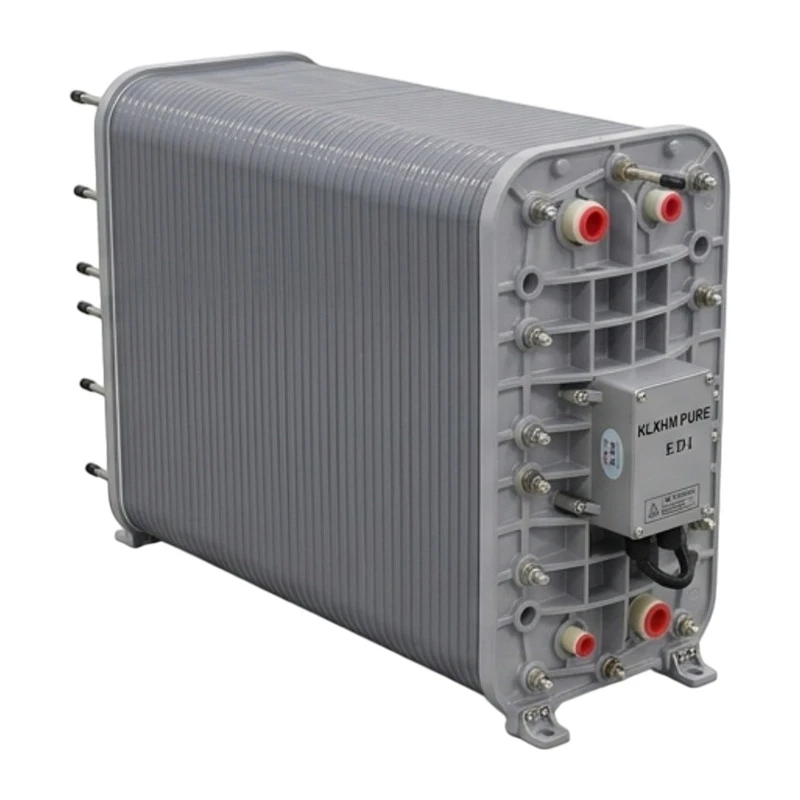
Over the last year, we've helped 22 mobile system integrators upgrade their old MBIX-based systems to large capacity EDI, and every one has reported lower operating costs and higher uptime. The client in Australia, for example, reduced their annual water treatment costs by $1.2 million after switching to our High Flow EDI Modules. That's the power of matching the right technology to the right use case. If you're designing a mobile water treatment system and wondering if large capacity EDI can work for your needs, the answer is almost certainly yes-if you prioritize modules engineered for mobile durability, low power use, and compatibility with variable feed water.
If you're ready to explore how our large capacity EDI modules can fit your mobile water treatment system, we're here to help. Whether you're working on a mining project, disaster response setup, or temporary industrial site, our team can walk you through module sizing, pre-treatment requirements, and operational best practices to build a system that works for your unique needs. Reach out to our sales team to start a discussion about your project today.
References:
- American Water Works Association. (2020). Mobile Water Treatment Technologies for Emergency Response and Remote Sites. AWWA Press.
- EDI Manufacturers Association. (2022). Large Capacity EDI Module Design for Variable Operating Conditions. Technical Report 003-2022.
- Global Mining Water Management Council. (2021). Remote Site Water Treatment Best Practices: Reducing Operating Costs and Environmental Impact. GMG Report 2021-04.
- International Water Association. (2023). Electrodeionization for Mobile Systems: Performance and Durability Testing. IWA Journal of Water Process Engineering, Vol. 52, Article 103567.
- U.S. Environmental Protection Agency. (2020). Chemical-Free Water Treatment for Remote and Emergency Use. EPA Guide 832-R-20-002.